 These are a Special Request for a Design Haus customer. I found some fun Animal Print Velvet in my stash of Vintage Fabrics.
Showing posts with label Get in the Spirit. Show all posts
Showing posts with label Get in the Spirit. Show all posts
Wednesday, September 7, 2011
Velvet Pumpkins
These are a Special Request for a Design Haus customer. I found some fun Animal Print Velvet in my stash of Vintage Fabrics.

Sunday, September 4, 2011
Halloween Glam
 Created using Orange Dupioni Silk, Black Spiderweb Lace, Vintage Millinery Trims and Feathers. It is nice to have an alternative for Halloween. Halloween Vintage Chic.
I am linking his to Addicted 2 Decorating.
Sunday, October 26, 2008
Wicked

This wicked little witch was created for a pumpkin auction for Juvenal Diabetes. Her body is a pumpkin that has been painted and holes drilled to make the lacey pattern.
Friday, December 21, 2007
Fizz and Food

Although dry sparklers are the perfect aperitifs enjoyed on their own (it's all because of the crisp acidity, light flavours and clean-tasting bubbles), they do go well with some dishes, especially:
Salmon and other fish mousse
Smoked salmon
Sushi
Crispy fried vegetarian dishes, such as tempura
Asparagus
Fresh prawns
Small filo parcels and creamy vol-au-vents
Spicy canapés, like tiny satay sticks
White fish dishes, such as grilled sole or plaice
Chicken in creamy sauces
Oysters
Salmon and other fish mousse
Smoked salmon
Sushi
Crispy fried vegetarian dishes, such as tempura
Asparagus
Fresh prawns
Small filo parcels and creamy vol-au-vents
Spicy canapés, like tiny satay sticks
White fish dishes, such as grilled sole or plaice
Chicken in creamy sauces
Oysters
Sunday, December 16, 2007
Raclette
 A dish indigenous to parts of Switzerland. The Raclette cheese round is heated, either in front of a fire or by a special machine, then scraped onto diners' plates.Traditionally, it is accompanied by small firm potatoes, gherkins, pickled onions, dried meats (such as prosciutto), sliced peppers, tomato, onion, mushrooms, pears, and dusted with paprika and fresh-ground black pepper. It is normally accompanied by a white wine, such as a Riesling or a Pinot Gris.
Saturday, December 15, 2007
Mistletoe Mojito
 1 oz. fresh lime juice
1 tbsp. superfine sugar
8 fresh mint leaves
2 oz. white rum
2 tsp. pomegranate seeds
4 oz. Pomegranate 7UP
1 mint sprig and 1 lime wedge for garnish
In a highball glass, muddle lime juice, sugar and mint leaves until sugar is dissolved.
Add rum and pomegranate seeds.
Fill glass with ice and top with Pomegranate 7UP.
Add rum and pomegranate seeds.
Fill glass with ice and top with Pomegranate 7UP.
Garnish with mint sprig and lime wedge. Enjoy.
Makes 1 mojito.
Makes 1 mojito.
Wednesday, December 12, 2007
Eiswein

[ICE-vyn]A German term meaning "ice wine," referring to a rich, flavorful dessrt wine. Eiswein is made by picking grapes that are frozen on the vine and then pressing them before they thaw. Because much of the water in the grapes is frozen, the resulting juice is concentrated-rich in flavor and high in sugar and acid. The resulting wines, extraordinarily sweet, yet balanced by high acidity.
Sunday, December 9, 2007
Mead

[MEED]A beverage made by fermenting honey, water, and yeast with flavorings such as herbs, spices, or flowers. Mead dates back to Biblical times and was popular in early England. Although not widely distributed today, it is still bottled. Mulled mead is a popular winter holiday drink, where mead is flavored with spices (and sometimes various fruits) and warmed, traditionally by having a hot poker plunged into it.
Thursday, December 6, 2007
Ginger Pomegranate Champagne Cocktail

1 cup Pomegranate juice
1 tablespoon superfine sugar
1 1/2 inch-thick slice fresh ginger
Fresh orange juice
Orange liqueur like Contreau or Grand Marnier
1 750-ml bottle brut Champagne or sparkling wine, chilled
Pomegranate jewels for garnish
Combine pomegranate juice, sugar and ginger in a pan over high heat stirring constantly until mixture is reduced to 1/3 of a cup. Remove ginger and set aside until cool. Pour 4 teaspoons of pomegranate syrup, 1 tablespoon orange juice, and 1 jigger orange liqueur into each of four Champagne flutes. Top off with champagne or sparkling wine. Garnish with a few pomegranate jewels.
Serves: 4
Combine pomegranate juice, sugar and ginger in a pan over high heat stirring constantly until mixture is reduced to 1/3 of a cup. Remove ginger and set aside until cool. Pour 4 teaspoons of pomegranate syrup, 1 tablespoon orange juice, and 1 jigger orange liqueur into each of four Champagne flutes. Top off with champagne or sparkling wine. Garnish with a few pomegranate jewels.
Serves: 4
Wednesday, November 28, 2007
Eau de Vie

[oh duh VEE]French for "water of life." This term describes any colorless, potent Brandy or other spirit distilled from fermented fruit juice. Among the grape-based eaux de vie are: eau de vie de marc, eau de vie de lie, and eau de vie de vin (from wine). Probably the two most popular eaux de vie in the world are Kirsch (from cherries) and Framboise (from raspberries).
Selecting Wine for Your Holiday Meal
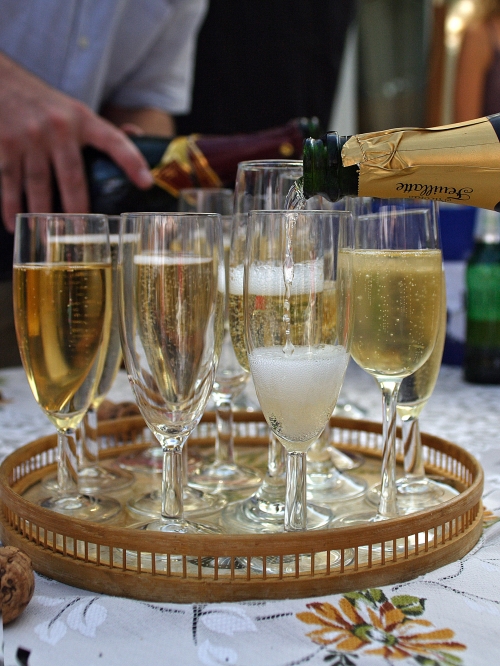
Even avid wine lovers can be struck with a temporary case of oenophobia — fear of wine — this time of year. The prospect of choosing a bottle that will please all of your guests and complement all of your dishes can perplex the most confident holiday host.
Here are a few helpful ideas:
Begin with bubbles. Offering guests champagne flutes along with hors d'oeuvres helps get everyone in a festive spirit.
Pick fruity wines for the table. Fruit-forward reds — such as Beaujolais, Pinot Noir, Syrah and Zinfandel and unoaked whites provide the most food-pairing flexibility. Among whites, look to Riesling. Serve a white and a red. Some guests invariably drink only one or the other.

Plan a happy ending. Pour a memorable dessert wine: Tawny Port would shine with a chocolate dessert, which has such a delightful, lingering finish that it just might accompany your guests all the way home.
 dessert, which has such a delightful, lingering finish that it just might accompany your guests all the way home.
 Wassail

WAHS-uhl, WAHS-ayl]Ves heill, Norse for "be in good health," is an old toast and the origin of this word. Wassail is a drink consisting of ale or wine sweetened with sugar and flavored with spices. This brew is traditionally served in a large "wassail bowl," garnished with small roasted apples and ladled into serving cups.
Wassail
Yield: 8 to 10 servings
Yield: 8 to 10 servings
8 cups larger-style beer
1/2 cup plus 2 tablespoons simple syrup (see note)

6 tablespoons lemon juice
1 teaspoon freshly grated nutmeg
1 teaspoon grated fresh ginger
4 cups dark rum
Apple slices, for garnish
Lemon slices, for garnish
In a medium saucepan, combine beer, simple syrup, lemon juice, nutmeg and ginger. Heat over medium-high until hot, about 8 to 10 minutes. Do not let boil. Add rum and stir well. Place apple and lemon slices in a heat-proof punch bowl. Add punch and stir 3 times.
Note: To make simple syrup, bring 2 1/2 cups water and 3 cups granulated sugar to a boil in a saucepan over medium-high heat, stirring occasionally. Reduce heat slightly; let boil slowly for 5 minutes. Remove from heat and let cool completely, then transfer to a jar and refrigerate until ready to use. Yield: 4 1/2 cups.
Monday, November 26, 2007
Racking

The process of siphoning off the clear juice from the sediment that has fallen to the bottom of the container either naturally or with the help of fining agents. During the winemaking process, racking can occur three or four times before the wine is clear. After racking, some wines are also filtered prior to bottling to remove any remaining miniscule particles.
Sunday, November 25, 2007
Quinta

[KEEN-tah]Portuguese for "farm," used to refer to a vineyard site or estate. Quintas, which are similar in connotation to the chateaus of Bordeaux, grow grapes for port, as well as for other wines. Many of the wines end up in house blends, but the concept of single-quinta wine, including single-quinta vintage port, is becoming more popular.
Saturday, November 24, 2007
Gamay

[ga-MAY]The full name of this French red wine grape is Gamay Noir a'Jus Blanc. Gamay wines have gained prominence in France Beaujolais region where this grape, which represents 98 percent of all vines planted, reigns supreme. They're so associated with Beaujolais that winemakers outside of the region often try to imitate the style of immediately drinkable, light- to medium-weight wines with high acid and low tannins. These light purple, fruity wines suggest flavors of bananas, berries, and peaches.
Thursday, November 22, 2007
Beaujolais Nouveau

Beaujolais nouveau is a red wine made from Gamay grapes produced in the Beaujolais region of France. It is the most popular vin de primeur, fermented for just a few weeks then officially released for sale on the third Thursday of November. This "Beaujolais Day", or "Beaujolais Nouveau Day" sees heavy marketing from the producers, with races to get the first bottles of the vintage to different markets.
Tuesday, October 16, 2007
Zinfandel

[ZIHN-fuhn-dehl] Grape that is considered California's red-wine grape because it's not widely grown in other parts of the world. Zinfandel vines were brought to California in the 1850s. By the 1880s this variety was rapidly gaining acceptance by California growers, and it is now that state's most extensively planted red grape. Zinfandel is vinified in many styles, which vary greatly in quality. One popular style is White Zinfandel, a fruity-flavored white wine that's usually slightly sweet and ranges in color from light to dark pink. When made into red wine, Zinfandel can produce wines ranging from light, nouveau styles to hearty, robust reds with berrylike, spicy flavors, plenty of tannins and alcohol.
Wednesday, October 10, 2007
Decanting

[dee-KANT-ing] verb: done either to separate the wine from any sediment deposited during the aging process or to allow a wine to breathe in order to enhance its flavor. When decanting an older wine, care should be taken not to disturb the sediment. A horizontal position keeps the sediment from disseminating throughout the wine. Once the foil and cork are removed, gently wipe the mouth of the bottle. Then begin slowly pouring the wine into a decantur, placing a strong light (a candle is charming, but a flashlight is more practical) behind or below the neck of the bottle. The light lets you see the first signs of sediment, at which point you stop pouring. You
Wednesday, October 3, 2007
Tannins

noun:[TAN-ihns]Any of a group of astringent substances found in the seeds, skins, and stems of grapes, as well as in oak barrels, particularly new ones. Tannins are part of a grouping technically called phenolic compounds. They are important in the production of good red wines because they provide flavor, structure, and texture and, because of their antioxidant traits, contribute to long and graceful aging. Tannins often give young wines a noticeable astringency, a quality that diminishes as the wine ages, mellows, and develops character. Tannins are detectable by a dry, sometimes puckery, sensation in the mouth and back of the throat.
Tuesday, October 2, 2007
Grenache

noun:[gruh-NAHSH] grape that comes in both red-wine and white-wine varietals. When used by itself, the word "Grenache" refers to the red version Grenache Noir, one of the world's most widely cultivated red grapes. The Grenache grape does well in hot, dry regions, and its strong stalk makes it well suited for windy conditions. It ripens with very high sugar levels and can produce wines with 15 to 16 percent alcohol. Grenache wines are sweet, fruity, and very low in tannins.The vine originated in Spain where it's called Garnacha; and is the most widely cultivated red-wine grape.
Subscribe to:
Posts (Atom)